
Close
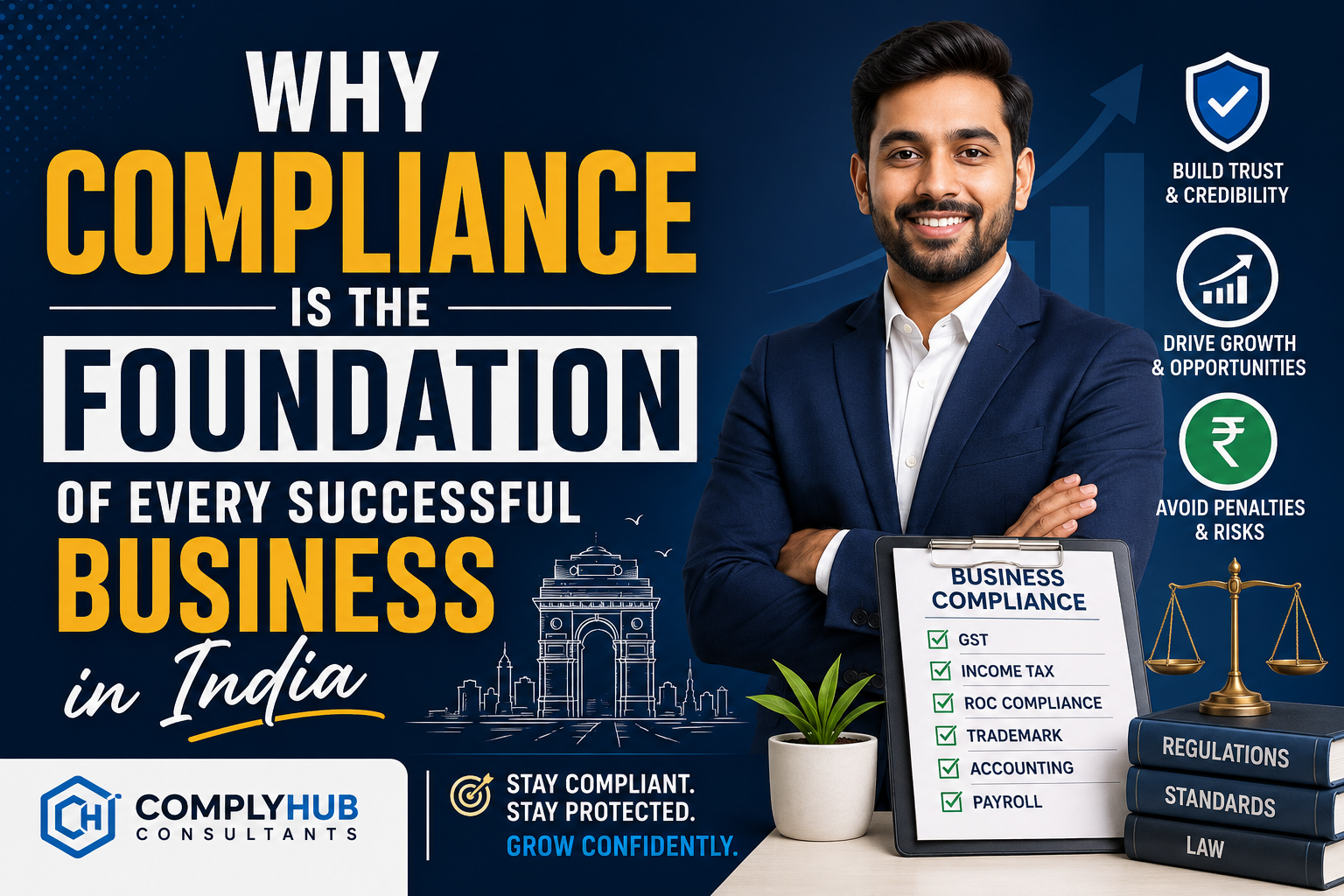
When most people start a business, compliance is rarely the reason they wake up excited in the morning.
They think about their first customer, their next sale, launching a new product, hiring a team, building a brand, or scaling operations. Compliance usually sits somewhere at the bottom of the priority list—something to deal with “later.”
Unfortunately, “later” often arrives in the form of a tax notice, a missed filing deadline, a rejected loan application, or a penalty that could have been easily avoided.
At ComplyHub Consultants, we’ve worked with startups, freelancers, small businesses, and growing enterprises across India. One thing remains consistent across every industry: businesses that treat compliance as a strategic function grow faster, face fewer disruptions, and build stronger foundations for long-term success.
This article isn’t about legal jargon or complicated regulations. It’s about understanding why compliance matters, how it impacts your business, and how proactive compliance management can become one of your strongest competitive advantages.
India is one of the fastest-growing economies in the world and offers incredible opportunities for entrepreneurs.
Today, anyone can launch an online store, start a consultancy, provide digital services, create a SaaS product, or establish a manufacturing business with relatively low barriers to entry.
However, alongside these opportunities comes a growing regulatory framework designed to ensure transparency, accountability, and fair business practices.
Whether you’re a freelancer earning your first income, a startup founder raising funds, or a company generating crores in annual revenue, compliance affects your business every single day.
The challenge is that many entrepreneurs don’t realize how interconnected compliance is with business growth until they encounter a problem.
A delayed GST return can affect vendor relationships.
Incomplete accounting records can create tax complications.
Missing ROC filings can lead to penalties.
Unregistered trademarks can put your brand identity at risk.
What appears to be a small oversight today can become a significant obstacle tomorrow.
Compliance simply means ensuring that your business follows all applicable laws, regulations, and reporting requirements.
Think of compliance as the maintenance schedule for your business.
Just as a vehicle requires regular servicing to function efficiently, a business requires regular compliance activities to remain legally and financially healthy.
Depending on your business structure and operations, compliance may include:
Many business owners assume compliance exists only to satisfy government requirements.
In reality, compliance serves a much larger purpose.
It creates trust.
It improves transparency.
It strengthens financial discipline.
And most importantly, it helps businesses scale without unnecessary legal and operational risks.
The answer is surprisingly simple.
Most entrepreneurs are busy.
When you’re handling sales calls, client meetings, product development, marketing campaigns, team management, and daily operations, compliance often feels like paperwork that can wait.
Some business owners also believe:
These assumptions are extremely common.
Unfortunately, they’re also responsible for many of the compliance challenges businesses face later.
Government systems today are more digitized and interconnected than ever before.
GST data, banking records, TDS information, company filings, and tax records can often be cross-verified automatically.
As a result, compliance mistakes that once went unnoticed are now easier to identify.
Most people think compliance penalties are limited to fines.
The actual cost is often much higher.
Let’s consider a simple example.
Imagine a startup that delays GST filings for several months.
Initially, the business owner may save some time.
However, the consequences can include:
Now multiply this across multiple compliance areas.
The cumulative cost becomes significant.
What could have been managed proactively for a modest amount often becomes a much larger financial burden.
Compliance isn’t an expense.
It’s risk management.
Trust is one of the most valuable assets any business can possess.
Customers want to work with reliable businesses.
Investors want to fund transparent businesses.
Banks want to lend to financially disciplined businesses.
Corporate clients want vendors with proper documentation and regulatory compliance.
Imagine two businesses offering similar services.
One maintains accurate records, files returns on time, and has complete documentation.
The other has inconsistent records and unresolved compliance issues.
Which business appears more trustworthy?
The answer is obvious.
Compliance directly contributes to credibility.
And credibility drives growth.
Many startup founders focus entirely on growth.
Growth is important.
But growth without structure can create serious problems.
Investors conducting due diligence often review:
A startup with incomplete records may face delays during fundraising or acquisition discussions.
On the other hand, startups that establish proper compliance systems from the beginning are often better prepared for expansion.
Good compliance practices signal professionalism and operational maturity.
These qualities matter to investors, customers, and partners alike.
One of the most common mistakes businesses make is delaying trademark registration.
Business owners invest months or even years building their brand.
They design logos.
They create websites.
They run advertising campaigns.
They establish market recognition.
Yet many fail to legally protect their brand identity.
Without trademark protection, your business name or logo may be vulnerable to misuse.
Imagine discovering that another company has registered a similar trademark after you’ve already invested heavily in branding.
The consequences can be costly and disruptive.
Trademark registration isn’t merely a legal process.
It’s an investment in your brand’s future.
Accounting isn’t just about taxes.
It provides visibility into the financial health of your business.
Accurate bookkeeping helps answer critical questions:
Without proper accounting, business decisions often rely on assumptions rather than facts.
Many businesses discover financial issues only after they become serious.
Regular accounting and bookkeeping provide the clarity needed for informed decision-making.
There is a misconception that compliance slows down growth.
In reality, the opposite is true.
Businesses with strong compliance systems often grow faster because they spend less time resolving preventable issues.
They are better prepared for:
Compliance creates operational stability.
Stability creates confidence.
Confidence supports growth.
The compliance landscape has evolved dramatically over the past decade.
Government portals have become increasingly digital.
Reporting requirements are more automated.
Data verification processes are more sophisticated.
While technology has simplified many processes, it has also increased the importance of accuracy.
Errors can be detected more quickly.
Deadlines are monitored more closely.
Businesses must adapt to these changes by maintaining organized systems and professional support.
Through our experience working with businesses across various sectors, we’ve observed recurring challenges:
Many business owners struggle to track multiple filing dates throughout the year.
Missing records create complications during audits and assessments.
Without expert guidance, businesses may pay more tax than necessary or expose themselves to compliance risks.
Many entrepreneurs rely on fragmented information from multiple sources rather than receiving structured professional advice.
As businesses expand, compliance requirements become more complex.
Processes that worked during the early stages may no longer be sufficient.
At ComplyHub Consultants, we understand that business owners have limited time.
Your focus should be on building your business—not navigating complex regulations.
Our goal is to simplify compliance through professional guidance, proactive support, and reliable execution.
Our services include:
Our mission is simple:
To help businesses remain compliant, reduce risks, and focus on growth with confidence.
Every successful business is built on a strong foundation.
While marketing drives visibility, sales drive revenue, and innovation drives differentiation, compliance provides stability.
It’s the invisible framework that supports sustainable growth.
Businesses that embrace compliance early often experience fewer disruptions, stronger financial management, improved credibility, and greater opportunities for expansion.
Instead of viewing compliance as an obligation, view it as an investment in the future of your business.
The businesses that thrive over the long term are rarely the ones that ignore compliance. They are the ones that build systems, maintain discipline, and create trust through transparency.
At ComplyHub Consultants, we’re committed to helping businesses across India navigate compliance with ease and confidence.
Whether you’re a startup founder, freelancer, MSME owner, or growing enterprise, our experts are here to help.
🌐 Website: https://complyhubindia.com
📧 Professional Compliance Solutions for Modern Businesses
📌 GST | ITR | Trademark | Company Registration | Accounting | Business Consultancy
ComplyHub Consultants — Simplifying Compliance, Empowering Growth.