
Close
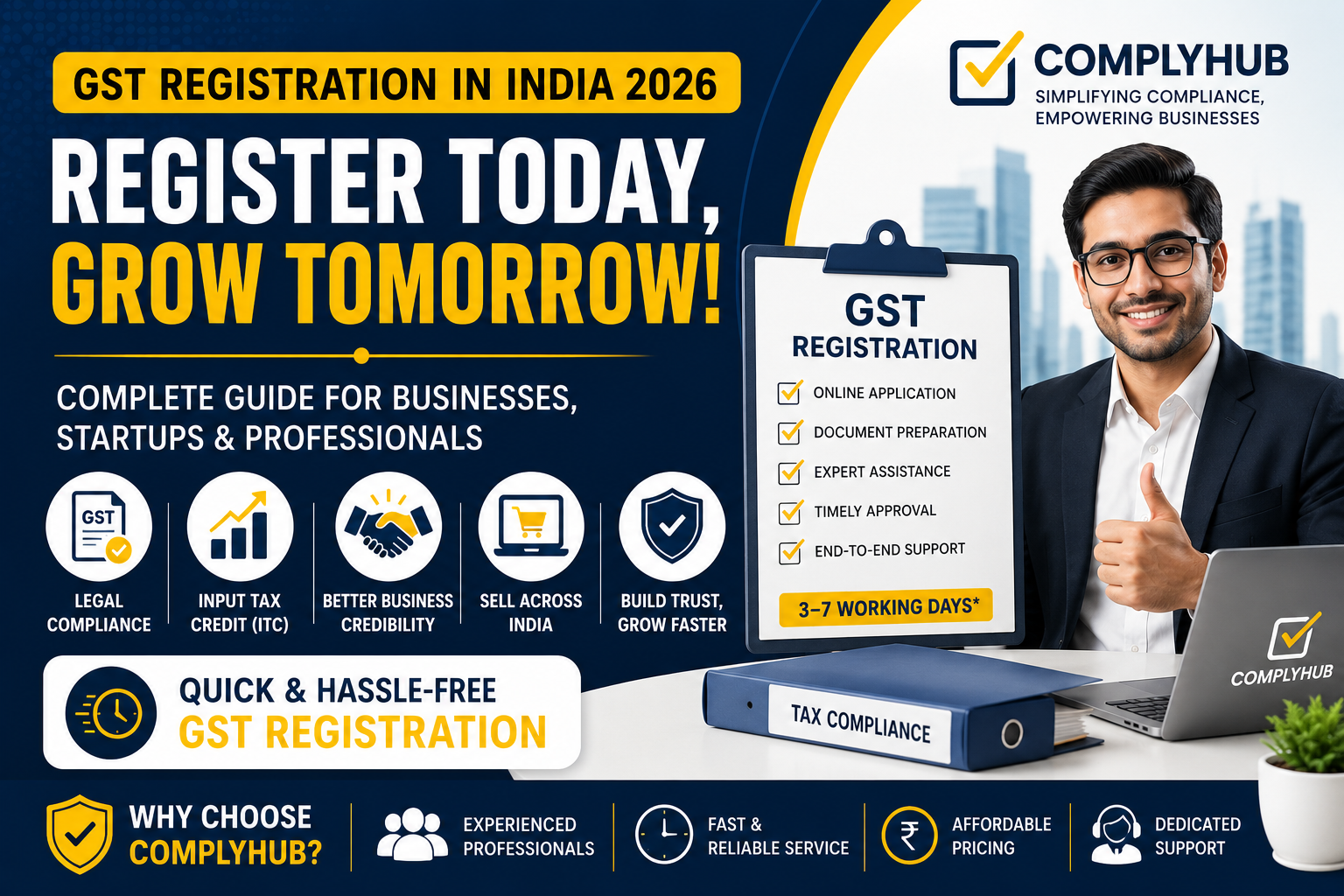
Goods and Services Tax (GST) has transformed India’s indirect taxation system by replacing multiple taxes with a single, unified tax structure. Whether you’re launching a startup, running an online business, operating a retail store, or providing professional services, understanding GST registration is essential for ensuring legal compliance and building a credible business.
For many businesses, GST registration is not just a legal requirement—it also enhances trust, enables input tax credit, and opens doors to working with larger organizations and government departments.
In this comprehensive guide, we’ll explain everything you need to know about GST registration in India, including who needs it, its benefits, required documents, the registration process, compliance requirements, common mistakes, and how ComplyHub can help.
GST (Goods and Services Tax) is an indirect tax levied on the supply of goods and services across India. Introduced on 1st July 2017, GST replaced several indirect taxes such as VAT, Service Tax, Excise Duty, Entry Tax, and others.
The objective of GST is to create a unified tax system, reduce cascading taxes, and simplify tax compliance for businesses.
Every registered business receives a GST Identification Number (GSTIN), which serves as its unique tax identity.
GST registration helps businesses operate legally while offering several commercial advantages.
A GST-registered business can:
Collect GST from customers
Claim Input Tax Credit (ITC)
Issue GST-compliant tax invoices
Expand across India without tax-related hurdles
Build trust among customers and corporate clients
Participate in government tenders
Sell on major e-commerce platforms
For many businesses, GST registration is a mark of professionalism and compliance.
GST registration may be mandatory in several situations, including:
Businesses whose annual turnover exceeds the prescribed limit under GST law are generally required to register.
Businesses supplying goods or services across state borders may need GST registration, subject to applicable provisions.
Businesses selling through platforms such as Amazon, Flipkart, Meesho, Myntra, or other online marketplaces often require GST registration.
Freelancers, consultants, agencies, software companies, marketing firms, and other service providers may need GST registration depending on their business activities and turnover.
Businesses engaged in international trade often require GST registration for smooth business operations.
Businesses participating in exhibitions, temporary events, or seasonal operations may also require registration under certain circumstances.
GST registration gives your business official recognition under India’s taxation system.
One of the biggest advantages of GST registration is the ability to claim Input Tax Credit.
Businesses can reduce their tax liability by claiming credit on eligible purchases used for business purposes.
This helps reduce overall operating costs.
Corporate clients often prefer working with GST-registered businesses because they can claim input tax credit on purchases.
Being GST-compliant also improves your business image.
Whether you’re opening branches in multiple states or selling nationwide, GST registration supports business growth.
Many government departments, multinational companies, and large organizations require vendors to have a valid GST registration.
Online marketplaces generally require sellers to provide GST details before listing products.
GST encourages better accounting practices and organized financial records.
India follows a dual GST model.
Collected by the Central Government on intra-state transactions.
Collected by the respective State Government on intra-state transactions.
Applicable on interstate transactions.
Applicable in Union Territories where relevant.
The documentation may vary depending on the business type.
Generally, the following documents are required:
PAN Card
Aadhaar Card
Certificate of Incorporation (for companies)
Partnership Deed (for partnerships)
LLP Agreement (for LLPs)
Electricity Bill
Property Tax Receipt
Rent Agreement (if rented)
No Objection Certificate (NOC)
Cancelled Cheque
Bank Statement
Passport-size photographs of the proprietor, partners, or directors.
Understand your business model, turnover, and registration requirements.
Collect and verify all necessary documents to ensure accurate filing.
The GST registration application is prepared and submitted through the official GST portal.
The GST department reviews the application and may seek clarification or additional documents if required.
Once approved, the applicant receives a GST Identification Number (GSTIN) and Registration Certificate.
The business can then legally collect GST and issue tax invoices.
The registration process generally takes 3 to 7 working days, depending on:
Accuracy of documents
Government verification
Additional clarification requests
Timely submission of complete documents helps avoid delays.
Obtaining GST registration is only the beginning. Businesses are also required to comply with ongoing GST obligations.
These may include:
Issuing GST-compliant invoices
Filing GST returns within prescribed timelines
Maintaining proper books of accounts
Paying applicable GST on time
Reconciling purchase and sales records
Preserving tax records as required under law
Regular compliance helps businesses avoid penalties and maintain a good compliance record.
Many businesses face unnecessary notices or delays because of simple errors.
Some common mistakes include:
Using incorrect PAN details
Providing an incorrect business address
Uploading unclear documents
Missing return filing deadlines
Claiming incorrect Input Tax Credit
Issuing invoices without mandatory details
Ignoring compliance even when there are no transactions
Professional assistance can significantly reduce these risks.
At ComplyHub, we simplify the GST registration process for startups, small businesses, professionals, and established companies.
Our experts ensure that your application is prepared accurately and submitted efficiently, reducing the chances of rejection or delay.
New GST Registration
GST Amendment
GST Cancellation
GST Revocation
GST Return Filing
GST Notice Assistance
LUT Registration
GST Advisory Services
Annual GST Compliance
Input Tax Credit Guidance
Businesses across India choose ComplyHub because we offer:
Experienced tax professionals
Transparent pricing
Fast documentation support
Dedicated compliance assistance
Timely return filing
Personalized business guidance
End-to-end GST solutions
Whether you’re starting your first business or managing an established company, our team is committed to making GST compliance simple and stress-free.
No. The requirement depends on factors such as turnover, business activities, and applicable legal provisions.
Yes. The application process is completed online through the GST portal with the required documentation.
Yes, subject to valid address proof and other applicable requirements.
Yes. Freelancers and professionals may register for GST depending on their business activities and legal requirements.
Failure to file GST returns within the prescribed timelines may result in late fees, interest, and other consequences under applicable law.
GST registration is an important milestone for businesses seeking legal compliance, financial transparency, and long-term growth. Beyond fulfilling statutory requirements, it enhances credibility, enables input tax credit, and supports expansion into larger markets and e-commerce platforms.
However, successful GST compliance doesn’t end with registration. Timely return filing, proper record maintenance, and adherence to applicable regulations are equally important.
Partnering with an experienced compliance firm can make the entire process smoother and help you focus on growing your business instead of navigating complex tax procedures.
If you’re planning to start a business or need assistance with GST registration, ComplyHub is here to help.
From document verification and application filing to ongoing GST compliance and advisory, our experts provide complete support at every stage.
📞 Phone: +91 98186 10979
🌐 Website: https://complyhubindia.com
ComplyHub – Your Trusted Partner for GST Registration, Tax Compliance, and Business Growth.